Skip to content

Use cases

Browse every published use case.

4 use cases

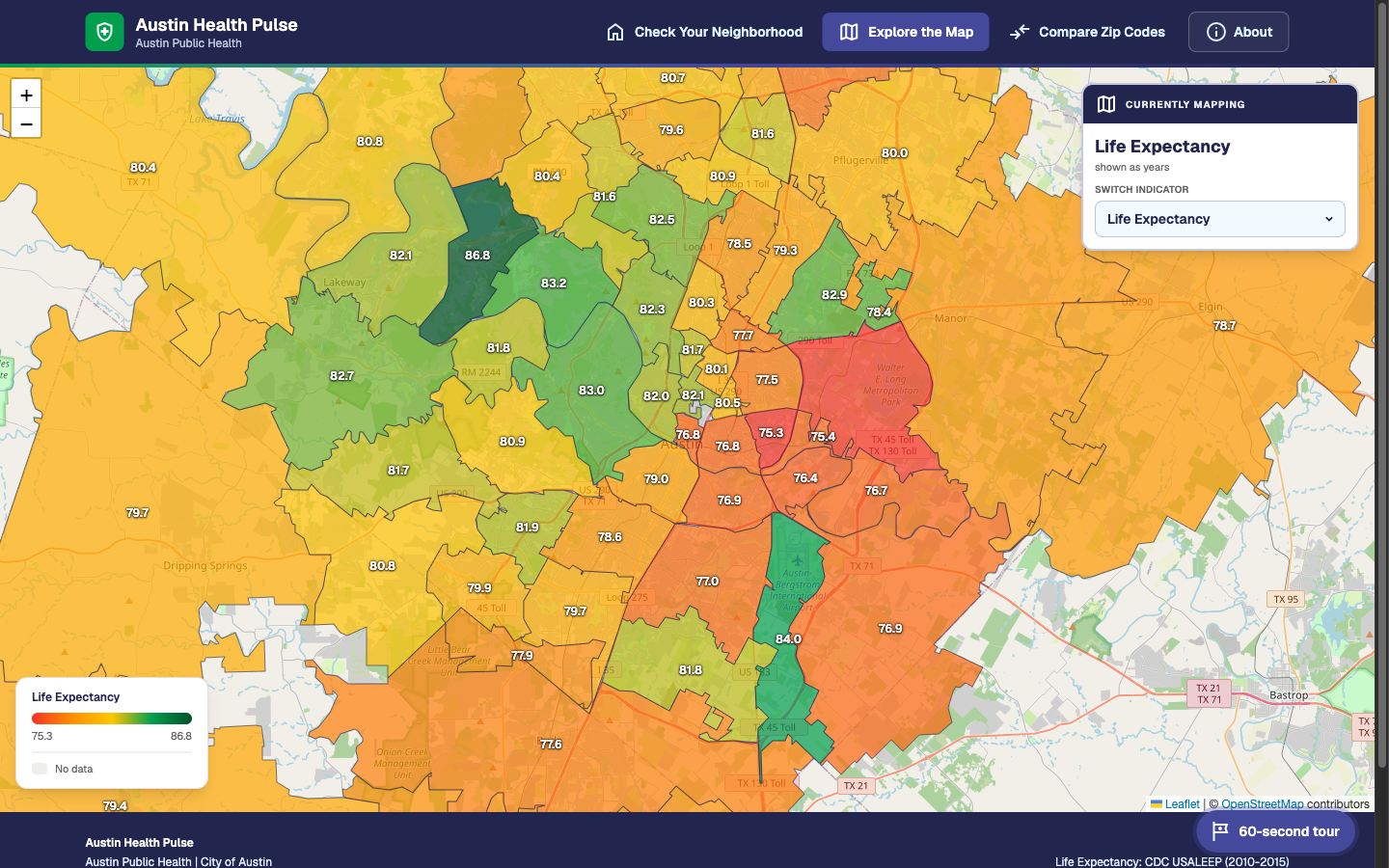
  • Map of Travis County ZIP codes shaded red to green by life expectancy, from 75.3 to 86.8 years.
    Open source

    Austin Health Pulse — life expectancy explorer by ZIP code

    Result in one line: Built in about 12 staff hours, against a typical agency estimate of 6–8 weeks

    An interactive map and calculator showing how life expectancy and health indicators differ across Travis County's 63 ZIP codes, with an 11.6-year gap between the longest- and shortest-lived.

    • Dashboard or visualization
    • Data pipeline or integration
    Skills needed to set it up: Developer Readiness: Needs customization Data it touches: Public data only Who sees the output: Public-facing
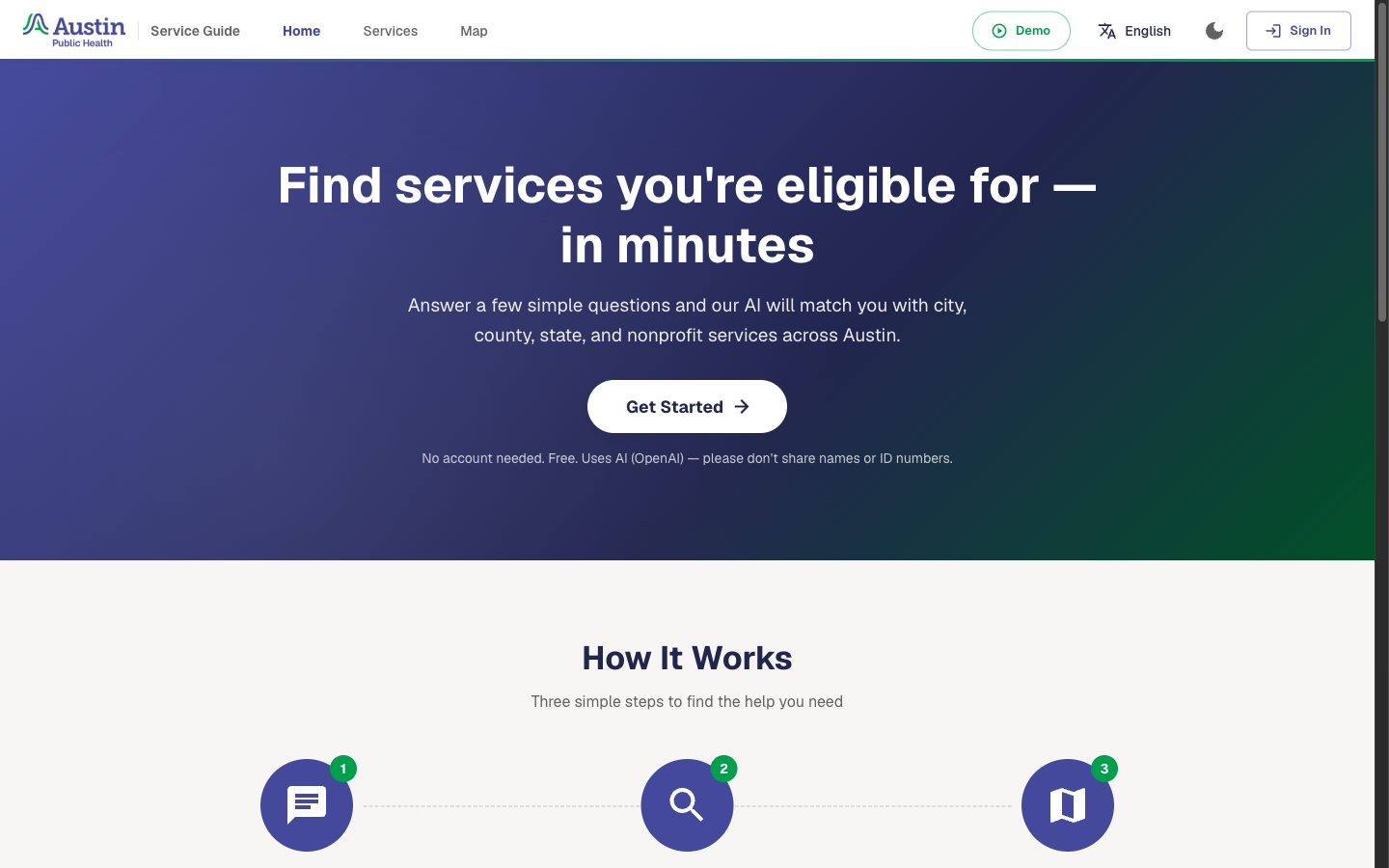
  • Landing page headline with a Get Started button and a note not to share names or ID numbers.
    Open source

    Austin Service Guide — AI-assisted service navigation

    Residents describe their situation in a short chat and get a ranked plan of local services they may qualify for, with hours, documents to bring, and a map.

    • Application or software
    • Generative AI tool
    Skills needed to set it up: Developer Readiness: Needs customization Data it touches: Public data only2 more
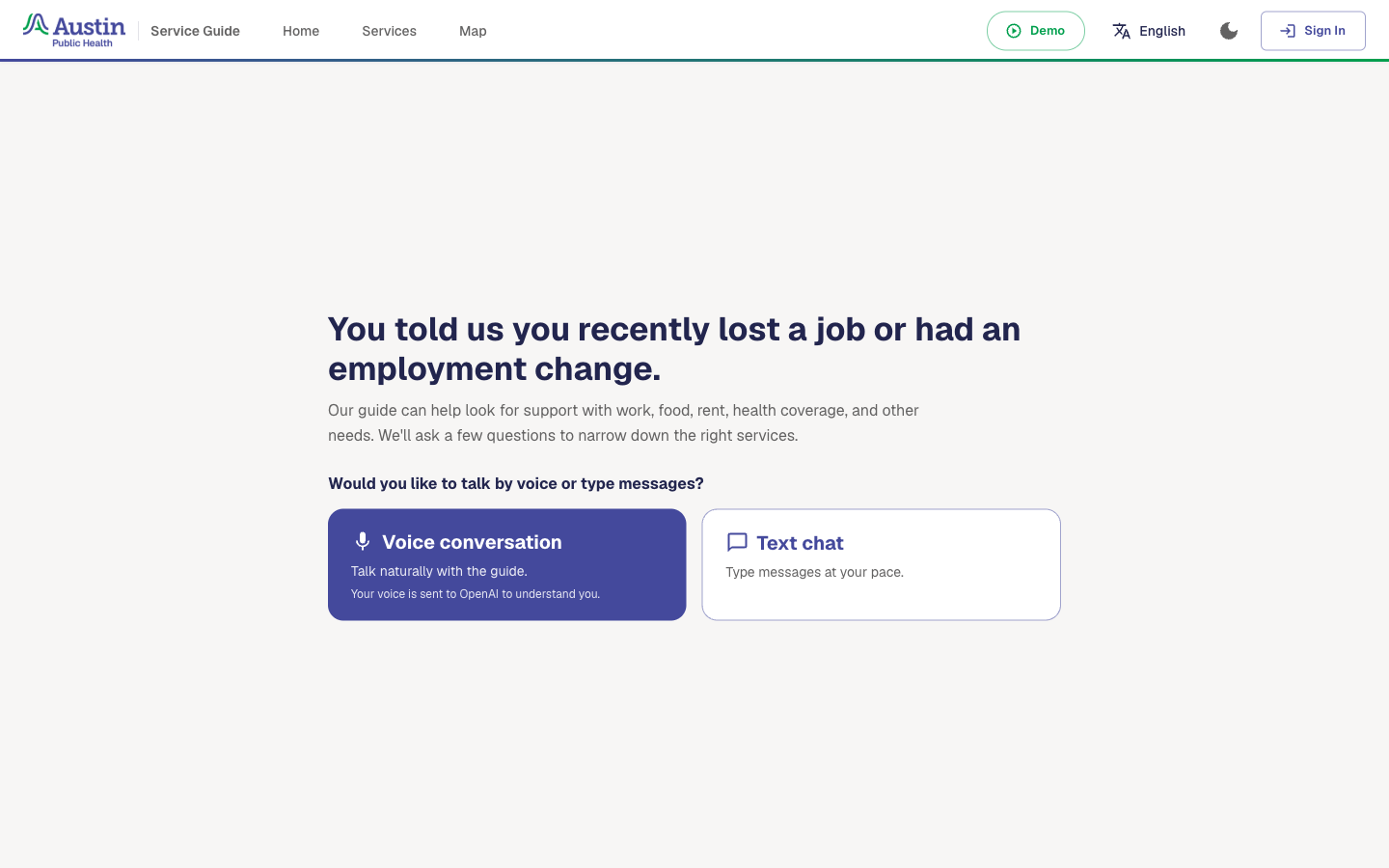
  • Choice between voice and text chat; the voice option says audio is sent to OpenAI.
    Open source

    Voice intake assistant for service navigation

    Residents can talk instead of type: a realtime voice assistant asks the intake questions, matches services from the catalog, and builds the same service plan as the text chat.

    • Generative AI tool
    • Application or software
    Skills needed to set it up: Developer Readiness: Needs customization Data it touches: Personal information (PII) Who sees the output: Public-facing
  • Machine learning record linkage

    Efficient and accurate way to link identities across datasets

    • AI/ML model
    Skills needed to set it up: Analyst or data scientist Readiness: Needs customization Data it touches: Personal information (PII) Who sees the output: Internal staff

Filter use cases

Type of solution (any of)
What do these mean?
AI/ML model
A trained model that predicts, classifies or detects something, such as a risk score or a forecast.
Generative AI tool
Drafts, summarizes, translates or answers questions with a large language model.
Data pipeline or integration
Moves, cleans or links data between systems: ETL jobs, feeds, HL7 or FHIR interfaces.
Analysis project or script
R, Python, SAS or SQL code and notebooks that answer a question or produce a report.
Dashboard or visualization
A Power BI, Tableau, ArcGIS or custom dashboard, map or chart others can rebuild.
Application or software
A web, mobile or desktop application that staff or residents use.
Data platform or infrastructure
A warehouse, lakehouse, cloud environment or infrastructure-as-code other teams build on.
Workflow automation
Takes a repetitive task off staff: Power Automate flows, scheduled jobs, robotic process automation.
Standards, governance or playbook
A data standard, governance policy, checklist, template or implementation guide.
AI use category
What do these mean?
Administrative & task automation
Forms, intake, scheduling, records — the routine work that eats staff time.
Communications, media & writing
Drafting, translating, summarising and publishing.
Coding & brainstorming
Writing or reviewing code, analysis, and idea generation.
Operations & logistics
Planning, dispatch, inventory, inspections and field work.
Public health area (any of)
What do these mean?
Communicable disease
Infectious disease control, immunization, STI, HIV, TB and outbreak response.
Chronic disease and injury prevention
Chronic conditions, tobacco, nutrition, violence, overdose and injury prevention.
Environmental health
Food safety, inspections, lead, housing, air and water quality, vectors, extreme heat.
Maternal, child and family health
Home visiting, WIC, prenatal and infant health, school-age health.
Access to and linkage with care
Clinics, community health workers, referrals and connecting residents to services.
Emergency preparedness and response
Planning for and responding to emergencies and public health incidents.
Epidemiology and surveillance
Case, syndromic, laboratory and wastewater surveillance, and the analysis behind it.
Vital records and health statistics
Birth and death records and the population health statistics built from them.
Communications and community engagement
Public information, risk communication, language access and community partnerships.
Data modernization and informatics
Shared data systems, interoperability and data governance that serve more than one program.
Agency operations and administration
HR, finance, grants, procurement, contracts, IT and legal work that keeps the department running.
Stage
What do these mean?
Idea / exploring
Scoping or prototyping; nothing in regular use yet.
Pilot
In limited use with real users while it is evaluated.
In production
In regular, supported use.
Paused or retired
No longer active — shared for the lessons.
Organization (any of)
Review status
What do these mean?
Reviewed & approved
Passed intake and Governance Committee review.
Under review
Published early, on purpose, while the committee's review continues.
Revisions requested
The committee has asked the submitter for changes.
Not yet reviewed
Listed before any review took place.
Deprecated
No longer maintained or accurate — kept for the record.